
Understand Commissions, Chargebacks, and Sales Bonuses
Understand Commissions, Chargebacks, and Sales Bonuses
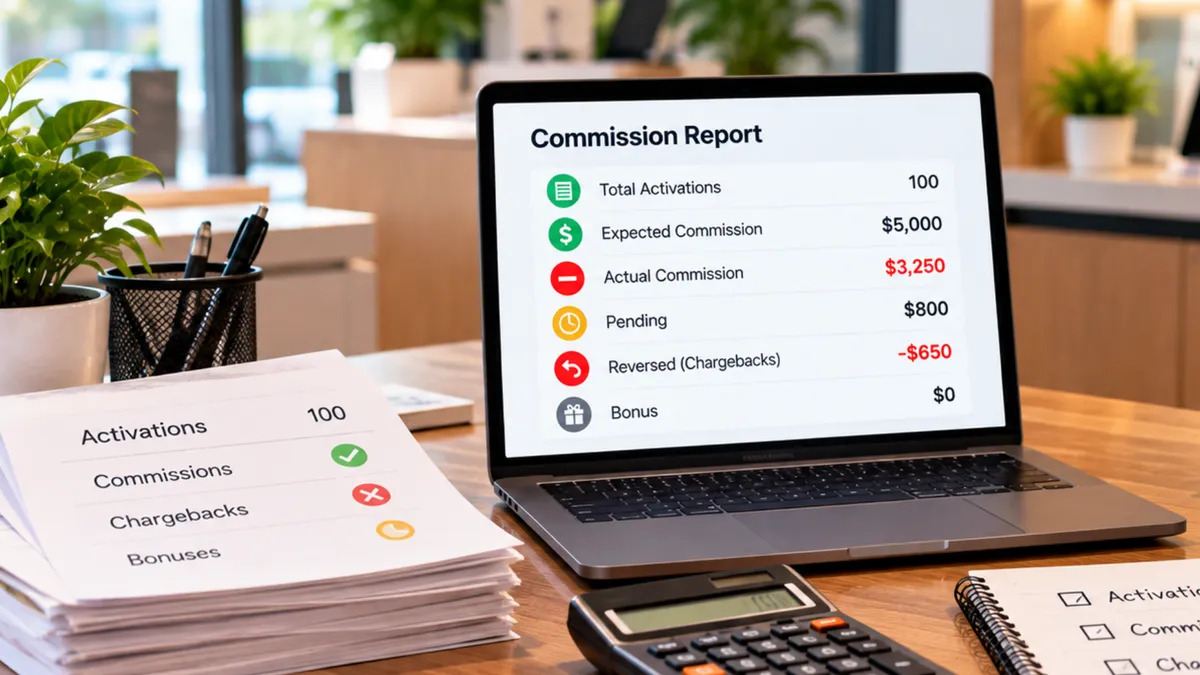
Imagine your wireless store has a strong month.
Your team completes 100 activations.
Employees meet their sales goals.
The store manager is excited about the results.
Based on the expected activation payouts, the owner estimates how much commission the business should receive.
But when the payment report arrives, the amount is lower than expected.
Some transactions are still pending.
Others did not qualify for the expected payout.
A few previously credited commissions have been reversed.
And a promotional bonus the owner expected is missing.
Now the owner has questions.
What happened to the money?
Was there a reporting error?
Did the store misunderstand the program requirements?
For independent wireless dealers, knowing how commissions work is just as important as completing sales.
A busy store does not automatically mean every transaction produces the earnings the owner expects.
An Activation and an Earned Commission Are Not Always the Same Thing
Wireless dealers may receive compensation for completing eligible transactions through authorized programs.
But not every activation automatically creates a final commission.
A provider may have specific qualification requirements.
For example, a transaction may need to be completed correctly, meet eligibility rules, or satisfy other conditions described in the agreement.
Some programs may also apply validation periods before a commission becomes payable.
The exact requirements vary.
That means a store owner should not calculate expected earnings by multiplying every activation by a single advertised payout without reviewing the rules.
Imagine a program advertises a $20 activation commission.
If the store completes 100 activations, the simple estimate would be $2,000.
But that is only an illustrative calculation.
Actual payable earnings depend on which transactions qualify, whether adjustments apply, and the program's payment terms.
A dealer needs to understand the difference between completed transactions, qualified transactions, and paid commissions.
Understand the Different Ways Wireless Dealers May Earn Money
Wireless businesses can generate income through several activities.
Some sell devices.
Others sell accessories.
Many complete prepaid activations or other authorized service transactions.
Some programs may provide additional compensation based on qualifying customer activity.
A store may also earn revenue from repair services or other products it is authorized to offer.
These earnings should not all be grouped together.
For example, revenue from selling a phone is different from the commission earned for activating service.
A prepaid refill transaction may also have a different compensation structure.
A promotional incentive may be paid separately from the normal activation commission.
Understanding these categories helps owners see where their business earnings come from.
What Are Residual Commissions?
Residual commissions are ongoing payments that may be earned under certain dealer or agency agreements.
Instead of receiving only a one-time payment, an eligible dealer may receive additional compensation tied to qualifying customer accounts or service activity.
For example, a program might offer an ongoing payment for each qualifying active line.
Another program may use a percentage-based calculation.
Some programs do not provide residual commissions at all.
The exact structure depends on the agreement.
A residual payment should never be assumed simply because a customer continues paying for wireless service.
Dealers need to confirm whether the program offers residuals, what qualifies, how payments are calculated, and when they may stop.
Why Residual Income Can Be Attractive
Imagine a store receives an eligible one-time commission when a customer activates service.
That payment is associated with a particular transaction.
Now imagine a different program provides ongoing compensation for qualifying customer accounts.
If those accounts remain eligible, the dealer may continue receiving payments according to the program's terms.
This can create a different revenue pattern.
But residual income is not guaranteed.
Customers may cancel service.
Accounts may become ineligible.
Programs may change.
Contracts may contain adjustment or termination provisions.
Owners should evaluate ongoing compensation using realistic assumptions rather than treating it as permanent income.
A Customer Paying Every Month Does Not Guarantee a Dealer Payment
This is an important point for prepaid wireless stores.
A customer may visit the same store every month to refill service.
That does not automatically mean the dealer receives residual commissions.
The store may receive compensation for a qualifying refill transaction.
It may receive a different type of payment.
Or the transaction may produce little or no dealer compensation, depending on the program.
Similarly, a customer who remains active on a carrier's network does not necessarily generate an ongoing payment for the original activating store.
The dealer must check the actual compensation agreement.
Do not confuse customer activity with guaranteed dealer earnings.
What Happens When a Commission Gets Reversed?
Imagine your store completes an activation and receives a commission.
Several weeks later, the commission report shows a negative adjustment.
The owner discovers that the provider reversed the original payment.
In dealer compensation, this may be called a chargeback, clawback, or commission reversal.
The terminology varies by program.
These adjustments may occur when a transaction fails to meet the requirements for final compensation.
For example, a program might reverse a commission if a qualifying account is canceled within a specified period.
Other programs may have different adjustment conditions.
The important point is that the store needs to understand the rules before counting the payment as final earnings.
Why Chargebacks Can Happen
Commission reversals can have several possible causes.
Depending on the program, they may involve:
A customer canceling service within a qualifying period
A transaction failing required validation
A duplicate or ineligible activation
An account failing to meet specified payment or activity requirements
A transaction identified as fraudulent
A correction to an earlier reporting or payment error
These are examples, not universal rules.
Each provider may define different triggers.
Some adjustments may occur soon after an activation.
Others may appear later.
Store owners should review the current program agreement to understand the applicable conditions and deadlines.
Not Every Negative Adjustment Is a Customer Cancellation
When dealers see a commission reversal, they may assume the customer stopped using the service.
But that is not always the reason.
The adjustment may involve missing documentation.
A transaction could have been processed incorrectly.
The activation may not have met a promotional requirement.
Or the report may contain a correction.
That is why employees and managers should avoid guessing.
Look for the transaction identifier, adjustment code, and relevant program documentation.
If the explanation is unclear, contact the appropriate authorized support channel.
Accurate investigation is better than assuming every reversal resulted from customer behavior.
How Chargebacks Can Affect Store Profitability
Imagine a store expects $3,000 in activation commissions for the month.
Later, the provider applies $400 in valid commission reversals.
The net amount from those commissions would be $2,600 before other business expenses.
These numbers are hypothetical.
The example shows why owners need to account for adjustments.
If the business spends its expected commission income before the payment is finalized, later reversals can create cash-flow pressure.
The store may still have rent, payroll, inventory, and other expenses to cover.
Dealers should distinguish projected earnings from confirmed payments.
They should also understand whether previously paid compensation remains subject to later adjustments.
Prevent Avoidable Problems Before the Activation
Some commission issues begin during the sales process.
An employee may enter incorrect information.
They may select the wrong program.
They might misunderstand eligibility requirements.
Or they may complete a transaction without following required verification steps.
These mistakes can affect both customer service and compensation.
Store managers should train employees to follow authorized activation procedures.
Before completing a transaction, confirm that the customer understands the service and that the correct program is being used.
Make sure required information is accurate.
Avoid shortcuts that could make a transaction ineligible or create compliance problems.
A correct activation is more valuable than a rushed activation that causes trouble later.
The Right Plan Can Help Reduce Customer Complaints
Imagine a customer asks for an affordable prepaid plan.
Your employee recommends a more expensive option because it has a higher promotional payout.
The customer agrees but later discovers the plan does not fit their budget.
They become frustrated and consider switching providers.
That is not a good outcome.
Employees should recommend service based on the customer's needs.
Ask about data usage.
Discuss coverage.
Explain hotspot availability where relevant.
Review the actual monthly cost.
Make sure the customer understands important plan conditions.
A suitable recommendation may improve the customer experience.
It can also reduce avoidable misunderstandings that sometimes contribute to early cancellations.
However, no sales approach can guarantee that a customer will remain active or that a commission will not be reversed.
Follow Up to Help Customers, Not Just Protect Commissions
Some stores contact customers after activation.
A follow-up can be useful when it has a legitimate service purpose.
For example, an employee may check whether the customer understands how to manage their plan or where to get support.
A customer might have questions about their device settings.
Another may be confused about the next payment date.
Helping customers resolve issues can improve their experience.
But follow-up communication must respect customer consent, privacy, and applicable marketing rules.
Employees should not pressure customers to remain on unsuitable service simply to protect a commission.
The goal is to provide useful support.
What Is a Spiff in Wireless Sales?
A spiff is an additional sales incentive offered under a particular program or promotion.
It may reward qualifying transactions, product sales, or achievement of specified targets.
For example, a provider might offer an additional bonus for eligible activations during a promotional period.
A distributor may have a separate incentive for qualifying devices or services.
Some promotions may include volume thresholds.
Others may apply to individual eligible transactions.
The details vary.
A spiff is not automatically part of the normal commission structure.
It is an incentive governed by the specific promotion's terms.
Promotional Bonuses Should Not Be Treated as Permanent Income
Imagine a store earns additional bonuses during a promotional month.
The owner becomes accustomed to those higher earnings.
Then the promotion ends.
The next month's commission total is lower even though the store completes a similar number of activations.
This can happen when a business treats temporary incentives as normal income.
Spiffs may change, expire, or have limited eligibility.
They may also be subject to validation or adjustment rules.
Owners should track promotional earnings separately from standard compensation.
This makes it easier to evaluate how the business performs without relying on temporary bonuses.
A Bigger Bonus Does Not Always Mean a Better Sale
Sales incentives can motivate employees.
But they can also create problems if the team focuses only on the bonus.
Imagine a customer needs a basic plan with enough data for messaging and occasional browsing.
A promotion offers an additional incentive for a different service.
The employee may feel tempted to recommend the promotional option even if it is not the best fit.
Store managers should make expectations clear.
Employees must follow program rules and recommend products based on customer needs.
A short-term bonus should never justify misleading claims, unauthorized activations, or unnecessary purchases.
Customer trust matters beyond the current promotion.
Explain Incentive Rules Before Employees Start Selling
If a store offers employee bonuses tied to eligible transactions, the rules should be clear.
Employees should understand what counts toward the incentive.
They should know when eligibility is determined.
They should understand when payment is expected.
The policy should also explain how corrections or disputed transactions are handled.
However, employers must be careful about deductions or recovering compensation.
A distributor reversing a commission does not automatically give the store permission to deduct that amount from an employee's wages.
Employee compensation practices must comply with applicable federal, state, and local employment laws.
Before changing payroll or commission policies, consult a qualified payroll or employment-law professional.
Know the Difference Between Store Commissions and Employee Pay
A wireless dealer may receive compensation from a carrier or distributor.
The dealer may then pay employees wages, commissions, bonuses, or another authorized combination.
These are separate arrangements.
The distributor's agreement determines how the dealer is paid.
The employer's compensation plan and applicable employment laws govern how employees are paid.
The two should not be treated as interchangeable.
For example, a carrier may delay payment to the dealer while reviewing an activation.
That does not automatically determine when an employee's wages are legally due.
Store owners should maintain clear documentation and seek professional guidance when designing compensation plans.
Read the Commission Agreement Before Joining a Program
Imagine a dealer is comparing two wireless programs.
One advertises a higher activation payout.
The other offers a different commission structure.
Which one is better?
The answer depends on more than the advertised number.
Owners should review the actual agreement.
Important questions include:
How is an activation commission earned?
Confirm the qualification requirements.
When are commissions paid?
Understand the reporting and payment schedule.
Are there chargeback or adjustment rules?
Review the triggers, time periods, and dispute procedures.
Are residual commissions available?
If so, determine how they are calculated and when they may end.
Are promotional bonuses offered?
Check the current terms rather than assuming past promotions will continue.
What happens if the dealer relationship ends?
Review any provisions affecting unpaid commissions, residuals, adjustments, and other contractual rights.
A qualified attorney can help evaluate significant contractual obligations.
Do Not Assume You Own Future Residual Payments
Some dealers believe that once they activate a customer, they automatically own the right to receive future compensation from that account.
That is not a safe assumption.
Any right to ongoing payments depends on the agreement.
A program may have specific conditions concerning customer eligibility, dealer status, termination, or assignment.
If a dealer switches distributors, the treatment of existing customer-related compensation may be especially important.
Before making a change, review the written contract.
Ask how existing accounts and unpaid commissions will be handled.
Do not rely only on verbal assurances.
Commission Reports Should Be Reviewed Regularly
A store owner should not wait until the end of the year to investigate commission differences.
Set aside time to review reports.
Compare completed transactions with the provider's records.
Identify which transactions are qualified, pending, paid, or adjusted.
Check promotional bonuses separately.
Look for duplicate entries or missing transactions.
Investigate unexplained negative adjustments.
Document any support requests and their outcomes.
This process can help owners understand actual earnings and identify operational issues.
It also creates a more reliable basis for financial planning.
Use Commission Patterns to Improve Employee Training
Suppose one store consistently has more commission adjustments than another.
That difference may deserve investigation.
But it does not automatically mean one team is performing poorly.
The stores may have different customer mixes, products, or program conditions.
Start by reviewing the reasons for the adjustments.
Are employees selecting the wrong activation category?
Are they misunderstanding a promotional requirement?
Are there recurring documentation errors?
Is the issue related to a particular provider?
Use the findings to improve processes.
Employee training should focus on accurate transactions and better customer service, not simply assigning blame.
Review the Real Cost of Each Sale
A commission report tells only part of the financial story.
The store may earn an activation payout, but it also has expenses.
Employees need to be paid.
The business pays rent and utilities.
Inventory requires capital.
Payment processing and other transaction costs may apply.
Some sales may require additional customer support.
And certain commissions may later be adjusted.
That is why store owners should consider gross profit and operating costs when evaluating performance.
A high commission does not automatically mean a highly profitable transaction.
Customer Trust Should Come Before Commission Size
Imagine a customer asks:
“Why are you recommending this plan?”
Your employee should be able to explain the recommendation based on the customer's needs.
For example:
“You mentioned that you use hotspot data for work. This option includes the hotspot features we discussed, and here is the monthly cost.”
That is better than recommending a plan solely because it pays a larger incentive.
If a customer asks whether the store receives compensation, employees should answer accurately and follow any applicable disclosure requirements.
They should not invent claims about identical online and in-store pricing or promise that dealer compensation never affects transaction costs.
Customers deserve accurate information about what they are purchasing.
Better Commission Management Starts With Better Questions
Wireless dealers cannot control every carrier policy or promotional change.
But they can control how carefully they review their business.
Before joining a program, understand the compensation terms.
Before promoting an incentive, confirm the eligibility requirements.
Before forecasting revenue, separate expected commissions from confirmed payments.
Before paying employee bonuses, make sure the compensation policy is clear and legally compliant.
And before recommending a plan, understand what the customer actually needs.
These habits help owners make more informed decisions.
A Busy Store Needs More Than High Activation Numbers
Completing activations is important.
But successful store management requires understanding what happens after the transaction.
Was the activation eligible?
Did the commission become payable?
Were any adjustments applied?
Did the promotion have additional requirements?
What did the store actually earn after relevant costs?
These questions help owners evaluate performance more accurately.
The goal is not simply to generate the highest possible activation count.
It is to operate a business that understands its revenue, manages risks, and serves customers properly.
Explore More Wireless Business Opportunities With UPD
Independent wireless dealers need accurate program information, suitable products, and dependable processes to manage their businesses effectively.
At Unlimited Prepay Distribution (UPD), we're focused on helping dealers explore available wireless programs, understand business opportunities, and strengthen their operations.
Whether you're reviewing activation compensation, comparing dealer programs, or improving your sales process, make sure your decisions are based on current written terms and the needs of your customers.
Want to explore more opportunities for your wireless store? Connect with Unlimited Prepay Distribution and learn how UPD can support your dealer business.


