
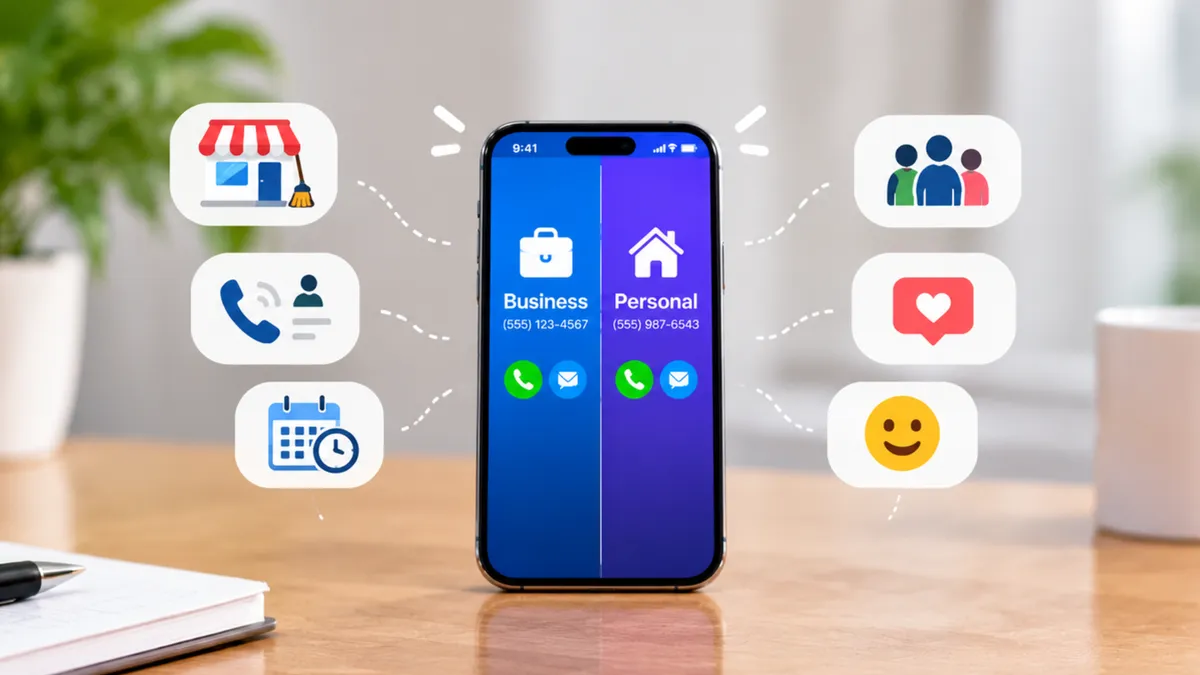
Help Small Businesses Manage Work and Personal Numbers on One Phone
Help Small Businesses Manage Work and Personal Numbers on One Phone
A customer walks into your wireless store looking for a new phone.
During the conversation, they mention that they run a small cleaning business.
They use the same phone number for everything.
Customers call to request estimates.
Employees call about their schedules.
Family members send messages.
Friends call in the evening.
And business customers sometimes contact them long after work hours.
The customer says:
“I wish I could keep my business calls separate without carrying two phones.”
That question creates an opportunity for a wireless dealer to provide useful information.
Depending on the device and available service options, a customer may be able to use two mobile numbers on one smartphone.
But the solution is not always as simple as adding another line.
Dealers need to understand what dual-SIM and eSIM technology can do, what it cannot do, and when a small business may need something more.
One Phone Number Can Become Difficult to Manage
Many small businesses begin with one person and one phone.
The owner answers customer calls personally.
They send estimates through text messages.
They coordinate appointments while traveling between jobs.
At first, using a personal number may feel convenient.
But as the business grows, communication can become harder to manage.
Customers may call during family time.
The owner may struggle to recognize which calls are personal and which are business-related.
An employee may need access to customer calls when the owner is unavailable.
And changing the business contact number later may require updating websites, advertisements, and customer records.
These problems do not affect every business in the same way.
But they are worth discussing when a customer relies heavily on a personal phone for work.
What Is eSIM, and Why Does It Matter?
An eSIM is a digital SIM that allows a compatible device to activate a mobile service profile without inserting a traditional removable SIM card.
Instead of placing a physical SIM into a tray, the customer follows the provider's supported activation process.
Some smartphones support a physical SIM and an eSIM.
Others can store multiple eSIM profiles.
Certain models can keep two lines active at the same time.
The exact capabilities depend on the device, software, carrier, and regional model.
For small-business customers, this technology may provide a way to use separate personal and work numbers on one compatible phone.
But employees should never assume that every eSIM-capable device supports the same dual-line features.
Always verify the specific model and intended service.
Two Numbers on One Phone Can Simplify Daily Communication
Imagine a local electrician who uses one phone for work and personal calls.
They want customers to contact a dedicated business number.
But they do not want to carry another device all day.
If their phone and service providers support dual-SIM operation, they may be able to maintain two numbers on one handset.
One number can be used for personal communication.
The other can be shared with customers as the business contact number.
On supported devices, the customer may be able to choose which line to use when placing a call or sending a message.
They may also be able to assign labels such as Personal and Business.
This can make the numbers easier to recognize.
However, having two lines does not automatically create separate contact databases, message histories, or business management systems.
The customer still needs to understand how their particular phone handles each line.
Dual-SIM and eSIM Are Related, but They Are Not the Same Thing
Customers sometimes use these terms interchangeably.
Dual-SIM describes a device's ability to support two mobile subscriptions or lines in a supported configuration.
eSIM describes a type of SIM technology.
A phone might support dual-SIM using one physical SIM and one eSIM.
Another model may support two active eSIMs.
Other devices may have different limitations.
For example, a phone may allow multiple eSIM profiles to be stored but only a limited number to remain active simultaneously.
Some dual-SIM phones also share certain radio resources, which can affect how calls and data behave when both lines are in use.
Employees should check the manufacturer's documentation and carrier requirements before promising a particular setup.
Ask How the Customer Actually Uses Their Phone for Work
Before recommending another line, ask a few questions.
What kind of business do they operate?
Do customers call them throughout the day?
Do they need to receive calls after business hours?
Does anyone else answer the business phone?
Do they want a separate number for privacy?
Are they trying to organize customer conversations or manage several employees?
The answers help determine whether a basic second mobile line is suitable.
For example, a freelance photographer who wants to keep their personal number private may benefit from a separate business contact number.
But a growing company with several employees answering the same customer line may need a more advanced communication service.
The right recommendation depends on the business's actual needs.
A Second Mobile Number Is Not a Complete Business Phone System
This is an important distinction for wireless dealers.
A standard second SIM or eSIM can provide another mobile subscription.
But it does not automatically offer every feature a business might need.
For example, adding another mobile number does not necessarily provide:
A shared company number that multiple employees can answer
Centralized business call records
Automatic call routing between employees
A business voicemail system with team access
Customer relationship management integration
Call recording or transcription
Administrative controls for company communications
These features may be available through separate business-calling platforms or specialized carrier-integrated services.
Employees should not promise them as standard eSIM capabilities.
If a customer needs advanced communication features, explain that a different type of service may be required.
When a Business Needs More Than Two Numbers
Imagine a plumbing company with five employees.
The owner receives nearly every customer call.
When the owner is working on a job, calls may go unanswered.
The business wants incoming calls to reach another available employee.
It also wants a consistent public contact number.
A standard second mobile line may not solve that problem.
The company may need a business phone service with call routing, shared numbers, or other team features.
Some unified communications platforms provide these capabilities.
Unified communications generally refers to services that combine business communication tools such as calling, messaging, and meetings.
Certain specialized offerings may also integrate business calling with mobile-network services.
But availability, functionality, and pricing vary significantly.
Wireless dealers should only recommend these products when they understand the authorized offering and its requirements.
Help Customers Understand the Difference Between Mobile Calls and Calling Apps
Some small businesses use internet-based calling apps.
Others use traditional mobile service.
These are not identical experiences.
An app-based calling service may depend on Wi-Fi or mobile data connectivity.
A native mobile call uses the device's supported cellular calling functions.
Both approaches can be useful.
Call quality and reliability depend on factors such as coverage, network congestion, internet conditions, device compatibility, and service configuration.
For example, a business owner who works in areas with poor mobile data coverage may have trouble using an internet-based calling app.
But ordinary cellular calls can also fail where cellular coverage is inadequate.
Employees should avoid promising that one method always provides better call quality.
Instead, ask where the customer works and what connectivity is available.
Contractors and Field Workers May Have Different Needs
A contractor who spends most of the day at job sites may have different communication requirements from someone working in an office.
They may need reliable calling while traveling.
They may want a dedicated number for customer inquiries.
They might also need mobile data for maps, scheduling, and job-management apps.
A second line may help separate personal and business calls.
But the customer should also consider coverage and device performance.
If the business operates across several locations, the employee should review the service provider's coverage information and explain its limitations.
Do not assume that an eSIM or additional line automatically improves reception.
The network and device still need to support the customer's usage locations.
Small Retailers May Need a Business Contact Number
Imagine a customer who owns a small convenience store.
They currently advertise their personal phone number on the store's social media page.
Customers call to ask about store hours and product availability.
The owner wants a separate number for those inquiries.
A compatible dual-SIM phone may provide one option.
However, the dealer should ask whether the number needs to be answered by other employees.
If only the owner handles calls, a second mobile line might be sufficient.
If multiple workers need to answer the same number, the business may need a shared calling service.
This distinction helps avoid recommending a product that does not solve the customer's real problem.
Privacy Is Another Reason Customers Want Separate Numbers
Some customers do not want their personal phone numbers displayed on business advertisements.
They may prefer to publish a dedicated business number on their website, social media accounts, or printed materials.
A separate line can help distinguish the numbers they share with different people.
But it is important to explain the limits.
Using two numbers on one device does not create complete privacy separation.
Both lines still operate on the same phone.
The device may share contacts, apps, storage, notifications, and other resources depending on its settings.
If the phone is lost or compromised, both lines may be affected.
Customers who need stronger business-data separation may require additional device-management or security solutions.
Check the Phone Before Promising a Second Line
Imagine a customer brings an older smartphone to your store.
They want to add an eSIM for business calls.
Your employee should not immediately promise that the setup will work.
First, identify the exact device model.
Check whether it supports eSIM.
Confirm the supported dual-SIM configuration.
Review the carrier-lock status.
Then verify whether the intended provider supports activation on that device.
Some phones support eSIM but may be restricted to certain carriers.
Others may have model-specific limitations.
A provider may also have additional activation eligibility requirements.
The safest approach is to use official manufacturer and carrier information before selling service.
Explain How Calls and Messages Will Work
A customer who has never used two mobile numbers may need help understanding the phone's settings.
On supported devices, the customer may be able to label each line.
They may be able to select a default line for outgoing calls.
The device may allow them to choose which line is used for certain conversations.
Mobile data selection may also be configurable.
But these features vary by phone.
For example, some devices have limitations when one line is already on a call.
Others may support different behaviors depending on Wi-Fi calling, network capabilities, or device settings.
Employees should explain the specific phone's supported features rather than promising identical behavior across all models.
A short demonstration can help customers feel more comfortable with the setup.
Moving an Existing Business Number Requires Planning
Some customers already use a separate business number.
They may want to move that number to a new provider or device.
Before beginning, confirm whether the number is eligible for transfer.
The customer may need account information, a transfer PIN, or other authorization details.
The requirements depend on the existing and receiving providers.
Employees should also ask whether the number is connected to important business services.
For example, it may appear on advertisements or be used for account verification.
A number transfer can involve temporary service interruptions or other provider-specific conditions.
Do not promise that every transfer will complete immediately.
Follow the authorized process and explain the expected steps.
Business Messaging Needs Special Attention
A business owner may use text messages to communicate with customers.
For example, a landscaper may send appointment reminders.
A salon may confirm bookings.
A delivery business may update customers about arrival times.
A separate business number may help organize these interactions.
But it does not automatically provide mass messaging, customer management, or marketing automation.
Those capabilities may require separate tools.
Businesses also need to follow applicable consent, privacy, and messaging requirements.
Employees should not tell customers that a second mobile line gives them permission to send unsolicited promotional texts.
The communication method must fit the business's legitimate needs and legal obligations.
Call Recording Is Not Automatically Included
Some businesses want to record calls for training, quality assurance, or documentation.
A customer may assume that using a business eSIM automatically provides recording.
That is not correct.
Standard dual-SIM functionality does not guarantee call recording.
Recording may require a supported device feature, specialized business service, or separate application.
It can also involve important legal requirements.
In the United States, call-recording consent laws vary by jurisdiction and circumstances.
Businesses may also have industry-specific privacy or recordkeeping obligations.
Dealers should not provide blanket legal assurances or promise recording features without verifying the actual service.
Customers considering recording should obtain appropriate legal guidance.
An Additional Line Should Solve a Real Problem
It can be tempting to recommend another mobile line to every customer who mentions a business.
But not everyone needs one.
A person who rarely receives work calls may be comfortable with their existing setup.
Another customer may already use a suitable business-calling service.
Someone else may prefer a separate physical phone for work.
The dealer's job is to understand the customer's needs.
Ask what problem they want to solve.
Is it privacy?
Missed calls?
Keeping personal and business contacts separate?
Managing multiple employees?
Then determine whether an available product addresses that problem.
A useful recommendation is more valuable than an unnecessary line.
Multiple Employees May Create Additional Wireless Needs
As a small business grows, it may need more devices or service lines.
For example, a cleaning company may hire two additional employees.
The owner might want each worker to have a business contact number.
A delivery service may need mobile data for another driver.
A contractor may want a dedicated device for a field supervisor.
These situations can create legitimate wireless opportunities.
But dealers should not assume that every business qualifies for a particular multi-line offer.
Review current service availability, device compatibility, pricing, and eligibility.
Explain whether the customer needs individual lines, shared calling features, or another solution.
The goal is to match the service to the business's operations.
Accessories Can Support Business Phone Use
A customer who relies on a phone for work may also need accessories that fit their daily routine.
For example, a delivery driver may benefit from a compatible vehicle mount.
A contractor may need a protective case.
A business owner who travels frequently may want an appropriate charging solution.
These are practical needs.
Employees should recommend accessories based on device compatibility and actual usage.
Do not assume that every business customer needs the most expensive accessory package.
Explain the options and let the customer decide.
Train Employees to Recognize Business Customers
A small-business opportunity may begin with an ordinary conversation.
A customer comes in to purchase a prepaid refill.
They mention that customers keep calling their personal number.
Another person asks whether one phone can receive calls from two numbers.
Someone else wants to know if employees can share a business line.
These questions can reveal different needs.
Store managers should train employees to listen for them.
Employees can ask:
“Are you using this phone mainly for personal use or for your business?”
“Do you want a separate number for customers?”
“Will anyone else need to answer business calls?”
“Are you trying to manage calls from one phone or across a team?”
The answers help determine whether a second line, another device, or a specialized business service might be appropriate.
Practice a Real Small-Business Conversation
Imagine a customer owns a home-cleaning business.
They say:
“My customers call my personal number all evening. Can I have a business number on this phone?”
The employee should first check the device's dual-SIM and eSIM capabilities.
Then they should ask whether the customer needs only a separate number or wants additional business calling features.
If a second mobile line is suitable and available through an authorized program, the employee can explain the activation and pricing requirements.
If the customer wants calls shared among employees, the employee should explain that a standard second line may not provide that function.
This exercise teaches staff to recommend based on the problem rather than the technology alone.
Make Sure the Customer Understands the Total Cost
An additional mobile line usually creates another service expense.
The exact amount depends on the provider and plan.
Some specialized business communication services may involve separate subscriptions, integration charges, or other fees.
Employees should explain the full recurring cost before activation.
They should also clarify whether the service requires a new number, number transfer, eligible device, or other setup.
Do not quote prices or promise business features that are not confirmed by the authorized provider.
A clear explanation helps the customer decide whether the solution fits their budget.
Small-Business Customers Can Become Long-Term Relationships
A small-business owner may begin with one phone.
Later, they may need an additional line.
They may replace a device.
They might need compatible accessories or another connectivity solution.
These needs can change as the business grows.
For wireless dealers, the opportunity is to become a helpful source of information when those needs arise.
That starts with accurate recommendations and dependable customer service.
It does not require promising products the store cannot provide.
When a customer asks about a new business need, review the available options and explain the limitations honestly.
Help Business Owners Choose the Right Communication Setup
A second phone number can be useful.
But it is not the answer to every business communication problem.
Some customers need a simple way to separate personal and work calls.
Others need shared business numbers, call routing, or centralized communication tools.
Some may prefer two physical devices.
The right setup depends on the business, the employees, the devices, and the services available.
Wireless dealers can help by asking good questions, checking compatibility, and explaining the options clearly.
A small-business customer may walk into your store looking for a phone.
They may leave with a better understanding of how to manage their business communication.
That is a valuable service.
Explore More Wireless Business Opportunities With UPD
Independent wireless dealers have opportunities to serve customers whose wireless needs extend beyond personal phones.
At Unlimited Prepay Distribution (UPD), we're focused on helping dealers explore available wireless products, understand service opportunities, and strengthen their businesses.
Whether your customers need compatible devices, additional mobile lines, or guidance on available connectivity options, make sure your team understands the programs it is authorized to offer.
Want to explore more opportunities for your wireless store? Connect with Unlimited Prepay Distribution and learn how UPD can support your dealer business.


