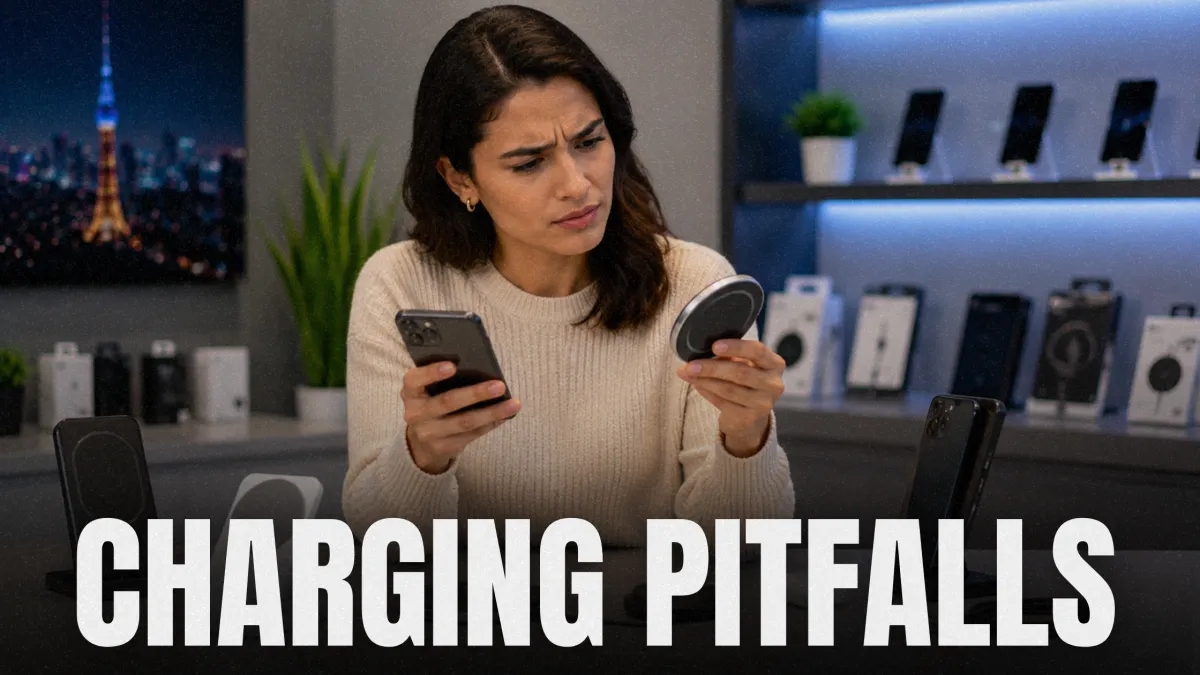
Wireless Charging Pitfalls Every Dealer Should Know Before Recommending Accessories
Wireless Charging Pitfalls Every Dealer Should Know Before Recommending Accessories
Wireless charging looks simple until a customer comes back to the store saying the charger is slow, the phone got hot, or it stopped working through the case.
That’s where a lot of dealers lose easy money.
Not because wireless charging is bad. Not because the customer has a bad phone. Most of the time, it’s because nobody explained the real issue before the sale. Bad alignment. Thick case. Cheap adapter. Metal plate. Wrong expectations.
I’ve been around this business long enough to tell you this straight: accessories can be one of the easiest ways to increase profit in a wireless store, but only if you recommend them the right way.
If you don’t, what should have been an easy upsell turns into a return, a complaint, or a customer who stops trusting your recommendations.
That’s why dealers need to understand wireless charging beyond the packaging.
Most customers don’t care about the technical names. They care about whether it works, how fast it charges, whether it gets hot, and whether they can use it without hassle. That means your job is not just to sell the charger. Your job is to guide the customer into the right setup.
The first thing to understand is this: not all wireless charging experiences are the same.
Qi is the standard most people are dealing with, whether they know the name or not. MagSafe adds magnetic alignment for iPhones, which makes charging more consistent because the phone snaps closer to the right position. That one difference matters more than people think.
In the real world, customers usually do not complain because wireless charging completely fails. They complain because it feels inconsistent. It starts charging, then slows down. It works one day, then feels unreliable the next. A lot of that comes down to alignment.
When the phone is not sitting correctly on the charging coil, performance drops. Charging slows down, extra heat builds up, and the customer assumes the charger is defective. A lot of the time, the charger is fine. The setup is the problem.
That’s why magnetic alignment matters. It helps reduce guesswork. It helps reduce those “it stopped charging” complaints. And it gives the customer a smoother experience, especially on iPhones using compatible magnetic accessories.
But even when alignment is right, dealers still need to set expectations.
Wireless charging is convenient, but it is usually not the fastest way to charge a phone. A customer in a rush should still be using a cable. Wireless charging is better for overnight charging, desk charging, or topping off during the day.
This matters because if the customer expects wired speed from a wireless charger, they’re already starting with the wrong expectation. That’s how returns happen.
Heat is another issue dealers need to explain clearly.
Phones warming up during wireless charging is normal to a point. Wireless charging creates more energy loss than wired charging, and that extra loss shows up as heat. That does not automatically mean something is broken.
What matters is why it is getting too hot.
A thick case can trap heat. A phone that is off-center on the pad can build extra heat. A magnetic plate or mount can interfere. Using the phone heavily while it charges, especially for gaming, streaming, hotspot use, or navigation, adds even more heat.
This is where dealers need to stop sounding like cashiers and start sounding like experts.
Instead of just saying, “It works with your phone,” the better move is to say, “It’ll work best with a thinner case, good alignment, and the right power adapter. If you use the phone hard while charging wirelessly, expect more heat and slower speed.”
That one conversation can save you a lot of headaches later.
Cases are one of the biggest reasons wireless charging goes wrong.
A lot of customers want heavy-duty protection, wallet-style cases, or magnetic attachments, and then expect wireless charging to work perfectly through all of it. Sometimes it does. A lot of times it doesn’t.
If the case is too thick, charging gets weaker. If there’s metal built into it, charging can fail completely. If there’s a wallet attachment or plate in the way, the customer may get poor charging, extra heat, or disconnects.
This is why dealers need to test and recommend combinations, not just single products.
The charger by itself is only part of the solution. The case matters. The adapter matters. The way the customer uses the phone matters. When you sell the right combo, returns go down and satisfaction goes up.
That is how good accessory selling works.
Another common problem is customers assuming that “magnetic” always means fully compatible.
It doesn’t.
A lot of accessories use magnets, but that does not mean the magnet placement is right, the strength is right, or the charging performance will be smooth. Some magnetic accessories look convenient but create weak alignment, inconsistent charging, or extra heat.
Again, this is where dealer knowledge matters.
If you know which accessories actually work well together, you stop being just another store selling products. You become the person helping the customer avoid bad purchases.
That matters for trust. And trust matters for repeat business.
Camera bumps create problems too, especially on certain phone models that do not sit flat on a wireless pad. If the phone rocks or sits unevenly, alignment gets worse. The customer may think the charger is broken when really the phone just is not making clean contact with the charging zone.
Multi-device chargers can cause similar confusion. They look clean and convenient, but they usually leave less room for error. If the phone is placed slightly wrong, the customer ends up frustrated. In the store, that means one more complaint you could have prevented with a better recommendation.
This is why dealers should always keep troubleshooting simple.
If a customer says wireless charging is not working, start with the basics. Remove the case. Remove any magnetic or metal attachment. Reposition the phone. Confirm they are using the right adapter and cable to power the charger. Let the phone cool down if it has been running hot. And make sure the phone actually supports wireless charging.
A lot of problems get solved right there.
And when the issue is the case or the attachment instead of the phone, that opens the door for another smart recommendation instead of a refund.
That’s how dealers should think about accessories. Not as one product at a time, but as part of a setup that either works smoothly or causes problems.
The best recommendation for most iPhone customers who want convenience is a magnetic alignment charger with a compatible case. That setup reduces placement issues and usually gives a more consistent experience.
For customers who want broad compatibility across multiple devices, a quality Qi charger with a thin case is usually the safer recommendation.
For customers who care most about speed, the truth is simple: wired charging is still the better option when they need power fast. Wireless is for convenience, not urgency.
That kind of honesty builds trust.
And trust sells better than hype.
At UPD, this is exactly how we think about dealer growth. It’s not just about having products on the shelf. It’s about helping dealers understand what to recommend, how to reduce returns, and how to turn simple accessory sales into better profit without creating more problems.
A lot of stores lose easy money because nobody trained the team on details like this. They sell the charger, skip the conversation, and then deal with the complaint later.
A better dealer approach is simple: explain clearly, recommend the right combo, and set expectations before the customer leaves.
That saves time. It protects the margin. And it makes the store look sharper.
Wireless charging is a good upsell when the dealer knows how to sell it right.
If you understand alignment, case compatibility, heat, and customer expectations, you will make better recommendations and deal with fewer returns. More importantly, you’ll build more trust with the customer standing in front of you.
And in this business, trust turns into repeat business.
Want dealer support that helps you sell smarter and grow profit?
UPD helps dealers with the real side of the business, products, support, training, and practical guidance that actually helps stores perform.
Connect with Unlimited Prepay Distribution and build with a team that stays involved.


