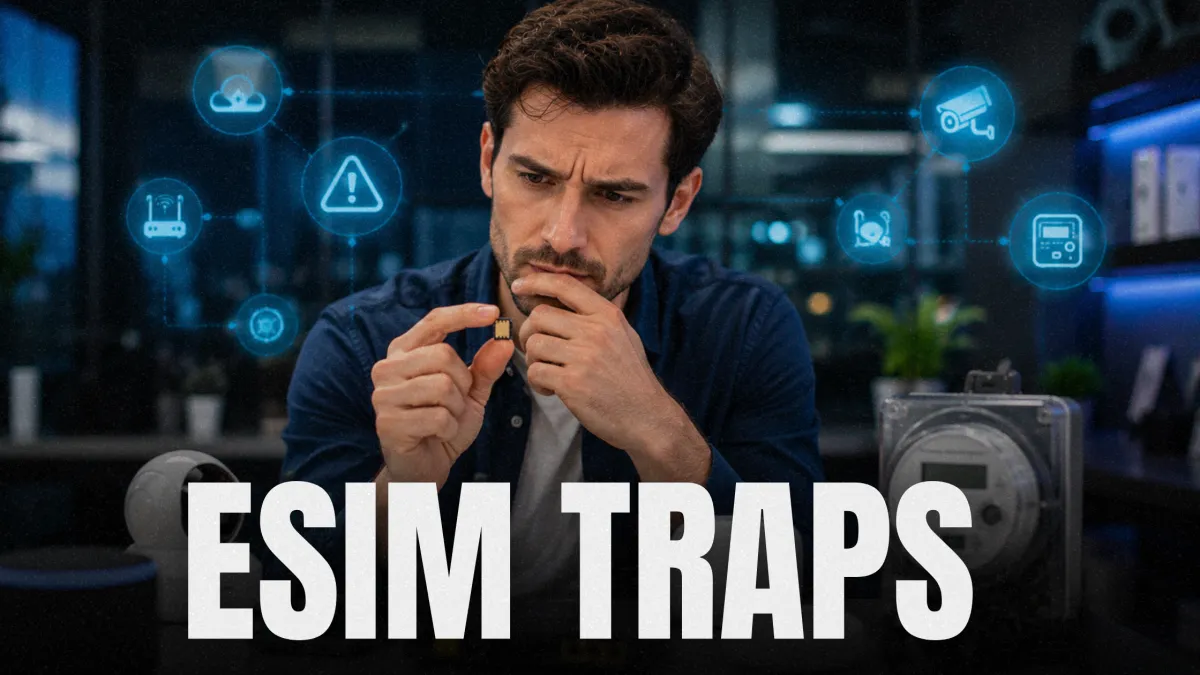
The Hidden Traps in IoT eSIM Rollouts Most Vendors Never Tell You
The Hidden Traps in IoT eSIM Rollouts Most Vendors Never Tell You
A lot of vendors make IoT eSIM sound cleaner than it really is.
They talk about flexibility, remote provisioning, easier profile management, less physical SIM handling, and no lock-in. On paper, it sounds like the perfect setup. That’s what gets a lot of people excited.
But once you get into the real work, the picture changes.
That’s when you find out the standard is one thing, and the deployment reality is something else. The technology might be solid. The promise might be real. But the hidden part is how vendors structure the deal, how platforms work together, and what kind of control you actually have after deployment.
And that’s where teams get caught.
I’ve seen this in wireless over and over. The problem is usually not the big sales pitch. The problem is what nobody explains clearly at the beginning. What looks flexible upfront turns restrictive later. What sounds open ends up locked down. What seems simple becomes expensive once you’re already too deep in it.
That’s exactly why this matters.
If you’re looking at IoT eSIM rollouts, especially under SGP.32, you cannot just listen to the high-level promise. You need to understand where the traps are before you commit.
The Standard Sounds Clean. The Deployment Usually Isn’t.
The promise behind IoT eSIM is strong for a reason.
Remote profile management is powerful. Less physical SIM handling makes sense. More control over connectivity across a device fleet is a real advantage. For the right business, that can save time, reduce operational headaches, and create more flexibility over the life of the deployment.
But that only works if the ecosystem behind it is actually open in practice.
That’s where people get blindsided.
A lot of teams think they’re buying one solution. They’re not. They’re stepping into a multi-vendor environment with moving parts that all have to work together cleanly. If one piece gets restricted, the whole idea of flexibility starts breaking down.
That’s the part vendors usually keep quiet.
You’re Not Buying One Thing. You’re Buying an Ecosystem.
This is one of the first things teams need to understand.
An IoT eSIM rollout is not just about putting a chip in a device. You’re dealing with multiple components that need to work together: the eUICC, the eIM, and the SM-DP+.
That sounds technical, but the business side of it is where people get hurt.
Why? Because those pieces often come from different vendors. One company might manufacture the chip. Another manages the control platform. Another handles profile generation and delivery. Everybody says they support the standard. Everybody says it works.
That doesn’t mean it works together the way you think it does.
A lot of “compliant” setups have never really been pressure-tested together in production. That means the risk does not show up in the pitch deck. It shows up later, when you’re already deploying devices and trying to operate at scale.
That’s too late.
Lock-In Still Shows Up, Just in Smarter Packaging
This is where a lot of people get fooled.
They hear words like open ecosystem, flexibility, and vendor-agnostic design, and they assume they’ll be free to move later. But lock-in doesn’t always show up as something obvious. A lot of times it comes disguised as configuration, policy, or contract structure.
That’s the real trap.
One example is SM-DP+ restrictions. On paper, your setup may look flexible. In reality, your eIM might only be allowed to work with specific SM-DP+ addresses. That means your switching options are limited before you even start. You think you have a choice, but the choice was already narrowed for you.
Another problem is post-deployment eIM locks. A team deploys devices, everything looks fine, and later they want to move to a different platform. That’s when they find out the eUICCs only accept commands from the original eIM. Now the business is trapped in the old setup, not because it has to be, but because the vendor designed it that way.
That’s not flexibility. That’s delayed lock-in.
Then there’s the reverse problem. Maybe you like your platform and want to source eUICCs from another manufacturer later. Some platforms don’t make that easy either. Now you’re tied to their chip and their connectivity decisions whether you want that or not.
And then you have bootstrap profile deletion locks. That one sounds small until it starts costing money. If a bootstrap profile becomes useless but can’t be removed, you’re carrying dead weight and ongoing cost for no real reason.
That’s how vendors hold on to accounts. Not always by saying no upfront. Sometimes by making exit difficult later.
Standards Compliance Does Not Mean Real Interoperability
This is one of the biggest mistakes teams make.
They hear “standards compliant” and assume that means clean interoperability across vendors. That’s a dangerous assumption.
In the real world, vendors can both be compliant and still fail together in production.
Certificate management, TLS implementation, infrastructure differences, platform behavior, profile transaction handling, and validation issues can all create problems that nobody warned you about. The system may look fine in a test environment and still break once it’s under real deployment conditions.
That’s a serious problem because when something fails, ownership gets blurry fast.
Now everybody points fingers. The chip vendor says it’s the platform. The platform says it’s the network. The network says it’s provisioning. The issue drags out, troubleshooting slows down, and your rollout stalls while everyone debates where the fault sits.
That’s why vendor relationships matter as much as technical claims.
If two vendors have not actually worked together successfully in production, then their compliance badge doesn’t mean nearly as much as people think it does.
The Wrong Questions Get Asked Too Late
This happens all the time in wireless.
Teams ask about features, pricing, roadmap, and launch timing. Those questions matter, but they are not enough. The real protection comes from the harder questions most people don’t ask until they’re already stuck.
Questions like:
Can the eUICC be reassigned later?
Can the platform manage chips from multiple manufacturers?
Can bootstrap profiles be deleted after deployment?
Can profiles be downloaded from any compliant SM-DP+, or only a limited set?
Who has actually completed real interoperability testing together?
What happens when profile operations fail?
What do the contract exit terms really look like?
That’s the difference between buying smart and buying blind.
The teams that protect themselves best are usually not the ones chasing the flashiest demo. They’re the ones asking what happens when they want to switch, scale, troubleshoot, or leave.
That’s how you find out whether a vendor is offering freedom or just marketing it.
If You Don’t Plan the Exit Early, You May Never Get One
This is one of the biggest truths in technology partnerships.
A lot of teams plan for the ideal scenario. Everything works, nobody needs to switch, pricing stays reasonable, performance stays strong, and the vendor relationship stays clean.
That’s fine on paper.
But smart operators plan for what happens if that changes.
What happens if pricing jumps later? What happens if service quality drops? What happens if the business grows faster than expected and the current setup stops fitting? What happens if the company gets acquired and needs to consolidate systems? What happens if a better partner enters the picture?
If you didn’t protect that flexibility upfront, your options later may be close to zero.
That’s why the exit matters just as much as the rollout.
A lot of businesses focus so much on getting launched that they forget to protect their future leverage. Then they spend years paying for that mistake.
Real Freedom Comes From Optionality, Not Just Technology
Technology matters. Of course it does.
But real freedom in an Iot eSIM rollout doesn’t come from the standard alone. It comes from optionality. It comes from keeping your ability to move, adapt, switch, and scale without getting boxed in by hidden technical or commercial decisions.
That’s what strong architecture should protect.
If a vendor truly believes in an open ecosystem, they should not be afraid of those questions. They should be ready to explain how reassociation works, how interoperability has been tested, how profile flexibility is handled, and what your real options are if you need to make changes later.
That kind of transparency is a strength.
The problem is, not every vendor wants to compete on transparency.
Want a partner that tells you the truth before the rollout gets expensive?
Whether you’re evaluating connectivity partners, planning a new deployment, or trying to avoid getting boxed into the wrong setup, the right guidance matters early.
Connect with Unlimited Prepay Distribution and build with people who understand how to spot the traps before they cost you.


